After five months of co-teaching this is still a difficult question to answer. My schedule change has allowed me to experience co-teaching with 5 different teachers. Co-teaching has the end goal of meeting the needs of students who learn differently.
One partnership I experienced was in a reading class. Students are required to interact with their text for 20-30 minutes and meet with the general education teacher every reading class. It was challenging to decide what students were going where and when! I questioned why there was even a need for a co-teacher with that model of reading instruction. An example of how this worked with a co-teacher was, one teacher pulling a small group and the other teacher assisting students with seat work (interacting with text). I would ask students to read aloud to me to ensure that they were comprehending and decoding correctly (not just sitting there flipping pages too). Another example of co-teaching is each teacher taking a small group and then switching after 10-15 mins. I enjoyed this model, but time was always running out.
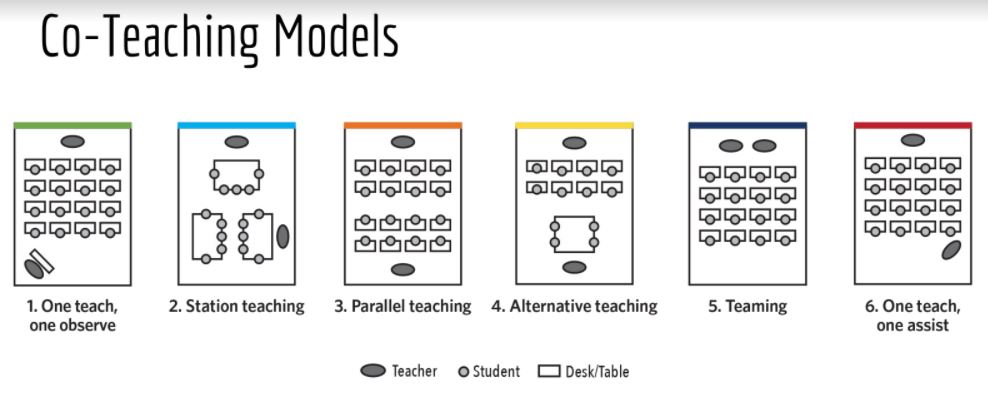
Other co-teaching experiences I have had followed the station teaching model. At our school reading, ELA, and math in the general education setting follow a workshop model. The whole group part of workshop model is frustrating to make work with co-teacher. Sometimes I lead the whole group part, other times I float or sit on the carpet with specific students, and I even pull students back for data collection or to target specific skills. Currently, me and my co-teacher split the whole group time. I am responsible for math calendar and number talks while she presents the students with the mini-lesson. After the whole group mini lesson, students go to centers or stations. This is when I think co-teaching is the most effective. Two teachers are leading two different activities. The activities can be anything from games, direct instruction, giving an assessment, problem solving, etc
I briefly tried parallel teaching for science(4th) and ELA(2nd). I thought it was a great way to teach students a lot of material at once, but it was loud and difficult to plan for. I did not think the actual process of planning two activities was difficult, but the materials and the space in the room needed for the activity was not always discussed prior to the lesson. Therefore, sometimes we both needed the smart board or we both needed the tables. I have asked other teachers what their experiences were with it and I have heard negatives and positives. A notable experience was that students were always concerned with what the other group was doing, and they were not focused on the teacher who was teaching them.
One partnership I experienced was in a reading class. Students are required to interact with their text for 20-30 minutes and meet with the general education teacher every reading class. It was challenging to decide what students were going where and when! I questioned why there was even a need for a co-teacher with that model of reading instruction. An example of how this worked with a co-teacher was, one teacher pulling a small group and the other teacher assisting students with seat work (interacting with text). I would ask students to read aloud to me to ensure that they were comprehending and decoding correctly (not just sitting there flipping pages too). Another example of co-teaching is each teacher taking a small group and then switching after 10-15 mins. I enjoyed this model, but time was always running out.
Other co-teaching experiences I have had followed the station teaching model. At our school reading, ELA, and math in the general education setting follow a workshop model. The whole group part of workshop model is frustrating to make work with co-teacher. Sometimes I lead the whole group part, other times I float or sit on the carpet with specific students, and I even pull students back for data collection or to target specific skills. Currently, me and my co-teacher split the whole group time. I am responsible for math calendar and number talks while she presents the students with the mini-lesson. After the whole group mini lesson, students go to centers or stations. This is when I think co-teaching is the most effective. Two teachers are leading two different activities. The activities can be anything from games, direct instruction, giving an assessment, problem solving, etc
I briefly tried parallel teaching for science(4th) and ELA(2nd). I thought it was a great way to teach students a lot of material at once, but it was loud and difficult to plan for. I did not think the actual process of planning two activities was difficult, but the materials and the space in the room needed for the activity was not always discussed prior to the lesson. Therefore, sometimes we both needed the smart board or we both needed the tables. I have asked other teachers what their experiences were with it and I have heard negatives and positives. A notable experience was that students were always concerned with what the other group was doing, and they were not focused on the teacher who was teaching them.
Comments
Post a Comment